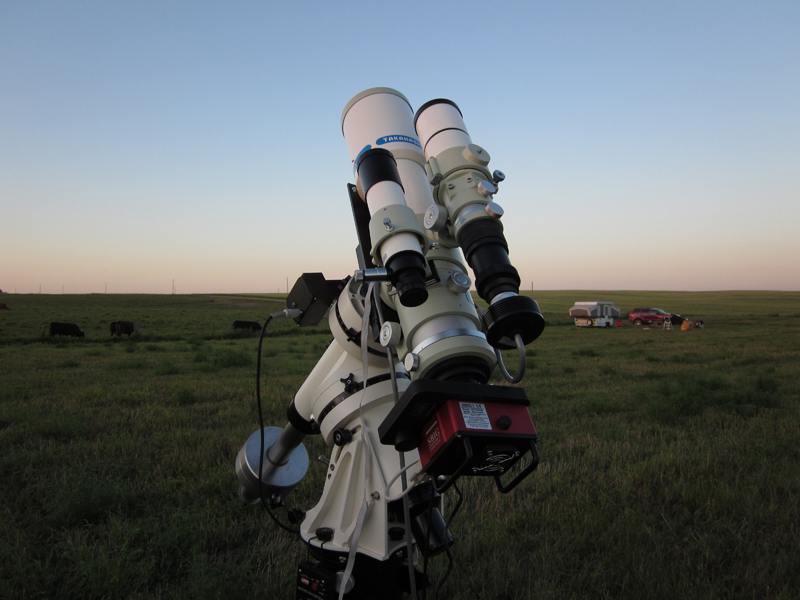
My "Tak Stack" from back in the day! And cows.
My "Tak Stack" from back in the day! And cows.
At this time I decided to get more serious about astrophotography and picked up a 16 inch f4.5 Newtonian with equatorial mount and I haven't stopped since! The film days were wonderfully simple compared to the more rigid requirements of digital imaging and so the equipment has evolved much over the years. Most of what I currently use is off the shelf, very little is home-made any more. Quite a contrast to the 60's and 70's when much of what people used was home made. There is now so much commercially available equipment that the combinations are virtually endless. There are now visual and photographic options available in almost any price bracket - you just need to decide how much you are willing to throw at this hobby! Be warned that once you start into this hobby, you will never be satisfied with what you have! There is always something bigger and better just around the corner.
I do not have a back yard so all of my imaging sessions have been in the field. It is great to be out
under the dark Alberta skies but the 200 foot trip to and from the car with all the equipment gets
harder as I get older! However, I do have a small front yard with a deck. My townhouse is
two stories high so limits my sky to straight up to the north. Better than nothing! With go-to computerized
telescope mounts and heavy light pollution filters I can do some shoots from home. A roll-out light blind
helps with both neighbour's lights and curious walkers by.
I am constantly changing my arsenal of equipment, here is the current lineup as of December 2025.

Me and the mighty Meade DS16 Newtonian in south Calgary

900QMD pictured with Vixen VC200L Scope

Sky-Watcher EQM-35 Pro

ZWO AM5N with Askar SQA55

EQ6-R Pro with Tak FSQ106N

Losmandy G-11 pictured with the Vixen VC200L and my old, yellow Datsun truck

Astro-Physics AP130EDT pictured with 900QMD and Monolith pier

Takahashi FSQ on G-11 Mount

"The Big one" dwarfing the imager!

The 8" Schmidt camera setup for film

How to take astrophotos during a hurricane!

Askar SQA55 ready for a night on the town.
The Vixen, on the 900QMD mount.

Smart Scope under construction
Wow, this has been a long list! In 1987 I acquired an Olympus OM1 and lenses as my primary astro camera. Around that time I also bought a Canda Technologies cold camera. This device used dry ice to cool the film to about -40C to improve film performance and colour balance. There are a few examples of how well this device worked scattered throughout the photo collections on this website. Most film images were taken with the OM1 or the later addition - the OM2. In 1992 I added an 8" f1.5 Schmidt camera to the collection. This photographic telescope bent film into a convex shape and brought wide field, high resolution images to the fold. With this camera I used primarily Kodak hypersensitized Tech Pan 2415 film. This camera filled the gap between camera lenses and prime focus with telescopes nicely. There are image examples scattered throughout the photo galleries on this web site. With a focal ratio of f1.5 this camera was incredibly fast!
I bought this camera in 1995 from my doctor, Dr. Fegler of Bragg Creek, Alberta. (R.I.P.) This unit was built primarily as an auto-guider and was based on the tiny TC-211 CCD sensor from Texas Instruments. I no longer own this camera. It wasn't all that great as an imaging camera though I did get a few images from it.
In March 2002 I started down the dark side with the purchase of my first CCD camera. From SBIG in California, the ST237a was my first stab at digital. The camera wasn't huge at 640 x 480 pixels but it was affordable. It showed me that a: my equipment wasn't good enough and b: you can't guide accurately enough manually for digital! Hence another bout of equipment upgrades from the DS16 mount purchased 1986, starting with the Losmandy G-11.
The ST237 I eventually added a colour filter wheel to in order to take colour images but in addition to the small pixel count, the camera sensor was rather noisy. My first upgrade was made possible by an offer from Brady Johnson who had an excess of ST-8 cameras and a need for an ST237 as a guider. So began my first self-guiding camera from SBIG. The guide chip was only the tiny ST4 TC211 chip but let me guide so much more accurately than by hand. Plus, there was no flexure caused by using a separate guide telescope. The CCD wasn't very efficient in the blue and image transfer was very slow via the parallel port on a laptop but it got the job done with a whopping 1500 x 1000 pixels. I was happy with this camera until Jim Janusz posted an ad on Astromart...
Woo-hoo! This was it! a serious CCD astro camera with enhanced blue sensitivity and (ironically) an ST-237 chip for guiding. I used this camera for several years and was very happy with its performance. You will find many images from this camera in the galleries. It was replaced when I got wind of Stuart Heggie selling his ST-10XME.
A much bigger sensor at 2000 x 1500 pixels, how could I go wrong? This camera was stunning. The sensor was amazingly quiet and was my first non-blooming gate camera, incredibly sensitive. Approaching 90% quantum efficiency, this was one of the more sensitive sensors from Kodak. I only recently sold this camera and had added almost every available accessory to it including the 10 position filter holder. However, the blooming of this camera meant that some targets were simply not easy to shoot! For example, shooting the Orion Nebula meant that I had to manually de-bloom 45 individual exposures, plus the exposure times were so short that I was unable to shoot long enough for good s/n ratio in the fainter parts of the nebula. And so I started my search for something to compliment the ST10. The big plus with this camera was that it had a 2nd CCD sensor - another ST237 - built in, used exclusively for guiding. This really simplified setup!
In November 2011, SBIG announced the MK. II version of their budget camera based on the 8.3 M-pixel Kodak sensor. This camera has small (5.4 micron) pixels with shallow wells making it a good match for my smaller scopes in addition to telephoto lenses. It was also anti-blooming making targets with bright stars in the field possible again. I ordered one with the 5 position filter wheel, leaving narrow band something for the ST-10XME to deal with. I never was able to get a flexure-free guide scope working with any of my scopes, so I now use the dedicated SBIG off-axis guider for this camera. It was purchased primarily for wide to medium field imaging leaving the ST-10XME for long focal length work.

The STF-8300M from SBIG
By 2020 or so it became apparent that CCD cameras were fading away and CMOS cameras were becoming a force
to recon with, with digital cameras. However, they had issues that I didn't want to deal with. Many of the cameras
at that time were only capable of outputting 12 bit data instead of 16 bit leading to lower resolution with greyscale.
On top of that they all suffered from something called "amp glow". The amplifier reading the data out of the chip
could produce a funky glow on one side of the image which CCD cameras did not have. But, Starvis 2 sensors by Sony
eliminated the glow and came out with 14 and 16 bit sensors. So, to test the waters I picked up a one-shot-colour
camera with the Starvis 2 IMX533 sensor in 2023, the ZWO ASI533MC Pro, which was also electrically cooled.
This camera exceeded my expectations! Good sensitivity, low noise, high resolution from the tiny 3.76 micron pixels.
There are many images from this camera on the site, I plan to keep this for a while unless I upgrade to a larger APS-C format version!
Click for more info
It quickly became apparent that the CMOS cameras had indeed reached a level of performance that met my expectations. So, I took the plunge and picked up a monochrome version of the IMX533 sensor. What a great camera! This time around I purchased the larger 36mm filters - just in case I ever wanted to upgrade to a larger sensor down the road. This included 3nm narrow band filters in hydrogen alpha, Sulfur II and Oxygen III. This turned out to be a wise move as I loved the camera so much I sold it and moved up!
In 2024 I bit the bullet, after having a good tax return I upgraded my ASI533MM to an ASI2600MM, moving the filters over. This camera is amazing! Very sensitive, very quiet, huge APS-C sized sensor. This is now my primary camera and I don't think it will get replaced. As I'm now in my later 60's there are fewer nights with boundless energy to take pictures and less spare cash to get rid of. But after all these cameras it has been a journey and what a great place to end up. I may possibly upgrade the ASI533MC to the ASI2600 version perhaps, we will see. But for now wow - it doesn't get much better than this!! For more info...
| Home - New - Comets - Solarsystem - Nebula - Galaxies - Clusters - Messiers - 110 - Film Shots - Odds - Equipment |