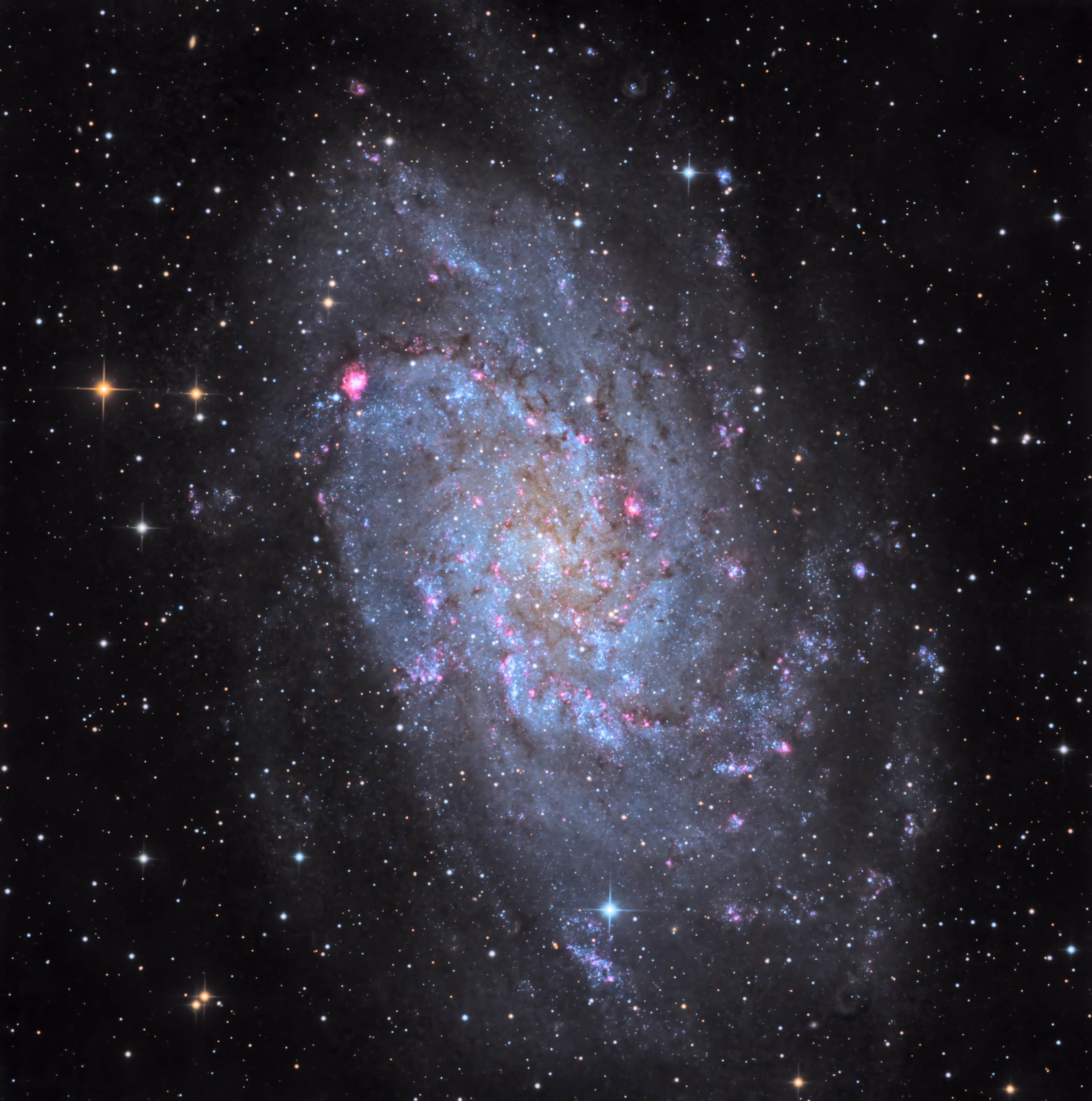
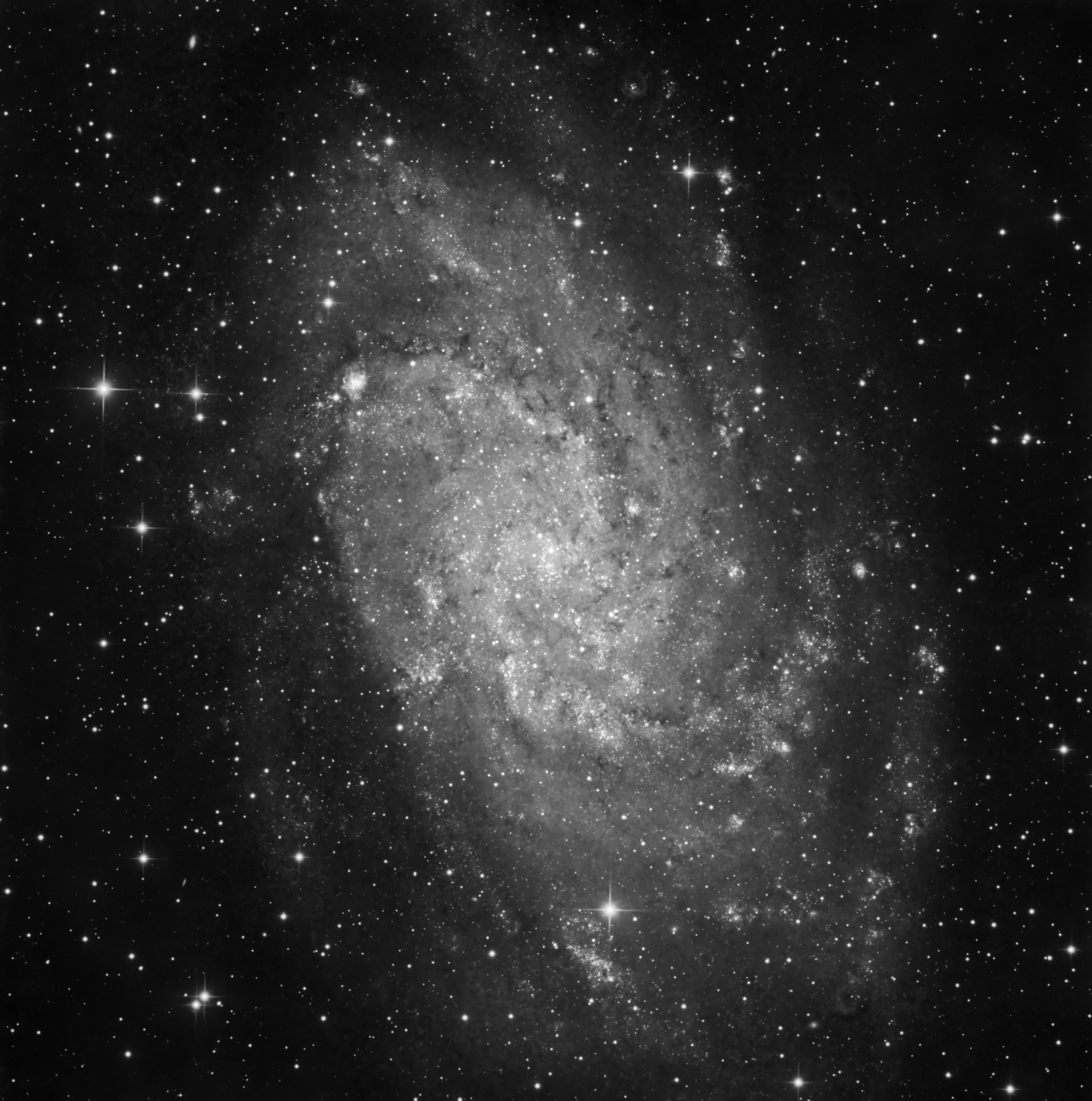
Probably discovered by Hodierna before 1654. Independently discovered by Charles Messier 1764.
The Triangulum galaxy M33 is another prominent member of the Local Group of galaxies. This galaxy is small compared to its big apparent neighbor, the Andromeda galaxy M31, and to our Milky Way galaxy, but this is more of an average size for spiral galaxies in the universe. One of the small Local Group member galaxies, LGS 3, is possibly a satellite of M33, which itself may be a remote but gravitationally bound companion of the Andromeda galaxy M31.
M33 is approaching us (our Solar System) at 182 km/s. Corrected for our motion around the Milky Way's Galactic Center, it is approaching our Galaxy at 24 km/sec.
M33 was among the first "spiral Nebulae" identified as such by William Parsons, the Third Earl of Rosse. It was also among the first "nebulae" identified as galaxies, in which Cepheid variable stars were found; Edwin Hubble published a fundamental study in 1926 (Hubble 1926).
The results of the Hipparcos satellite have lead to a revision of the cosmic distance scale, therefore also of our distance to M33: The current value is about 3.0 million light-years. With this value, its angular dimension of 73 arc minutes in major axis (about 2.5 times the Moon's diameter) corresponds to about 50,000 light-years, half the diameter of the Milky Way. However, the faintest outlayers seem to reach more far out, so that the true diameter may be at least 60,000 light-years. The mass of the Triangulum Galaxy has been estimated between 10 and 40 billion solar masses.
For the observer, this galaxy can be glanced with the naked eye under exceptionally good conditions; for most people, it is the most distant object visible to the naked eye. It is outstanding in good binoculars, but as its considerable total brightness is distributed quite evenly over an area of nearly four times that covered by the full Moon, its surface brightness is extremely low. Therefore, it is difficult to impossible to view this galaxy in telescopes which do not allow low magnification - lowest is best for this object ! M33 is also a most rewarding target for the astrophotographer, who can track down its spiral arms and brighter nebulae with considerably inexpensive equipment.
===============