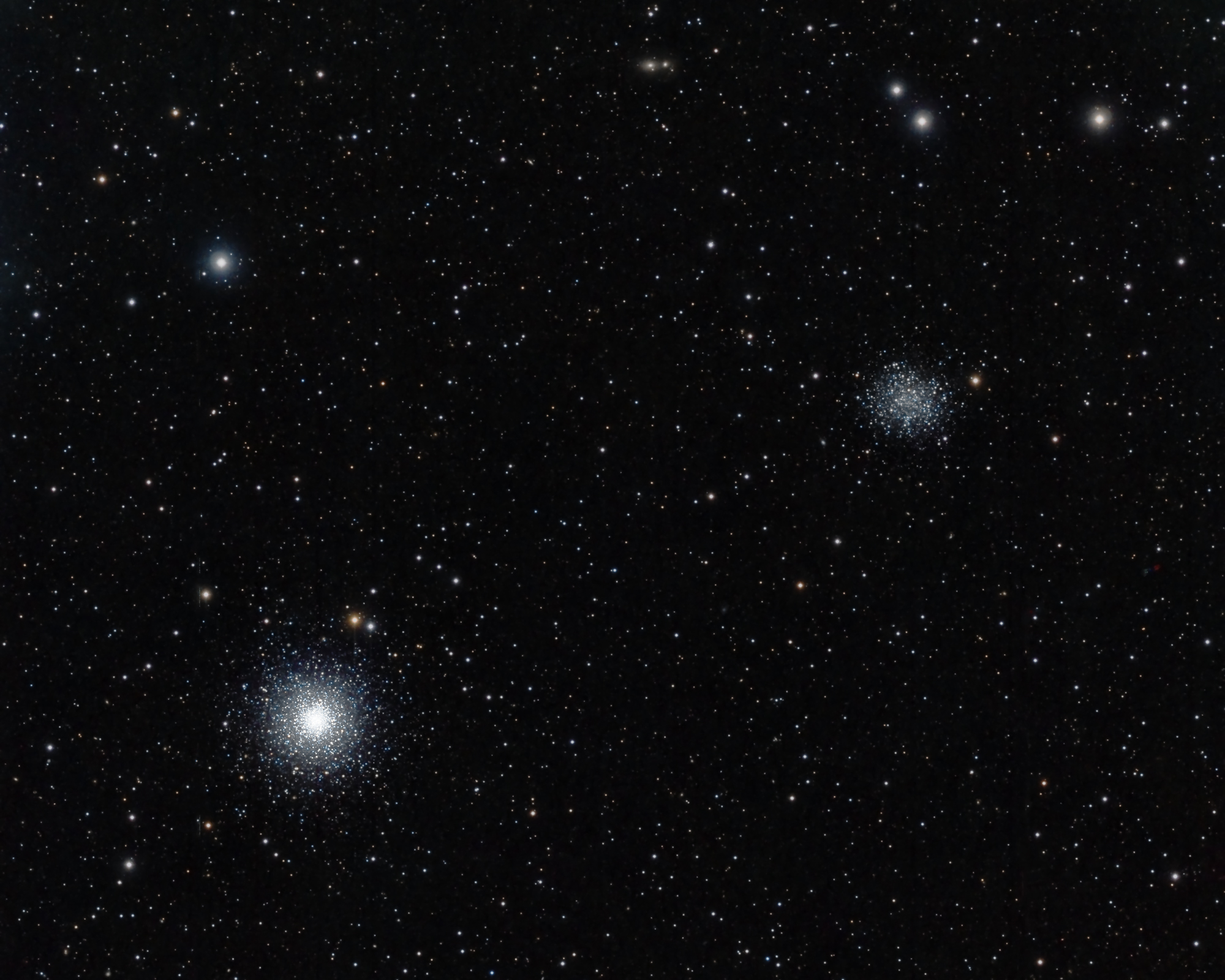
Messier
53 - Globular
Cluster
in Coma Berenices
M53 (bottom left) and NGC5053 (top right) [North is down in
this view]
From SEDS.ORG:
=======================
Discovered
1775 by Johann Elert Bode.
Globular star cluster Messier 53 (M53, NGC 5024) is one of the more
outlying globulars, being about 60,000 light years away from the
Galactic center, and almost the same distance (about 58,000 light
years) from out Solar system. At this distance, its apparent angular
diameter of 13' corresponds to a linear diameter of roughly 220 light
years. It is rapidly approaching us. M53 has a bright compact central
nucleus, although its stars are not very concentrated toward the center
when compared to other globulars, and a gradually decreasing density
profile to the outer edges.
Its discoverer Johann Elert Bode, who found it on February 3, 1775,
described it as a "rather vivid and round" nebula. Charles Messier, who
independently rediscovered and cataloged it two years later, on
February 26, 1777, found it "round and conspicuous" and that it
resembles M79. William Herschel was the first to resolve it into stars,
and found it similar to M10.
As in all globular clusters, the stars of M53 are apparently
"metal-poor", which means that they contain only little quantities of
elements heavier than helium (actually mainly elements like carbon and
oxygen); those of M53 are even below the average globular cluster
members in "metallicity". It contains the considerably respectable
number of 47 known RR Lyrae variables, some of them were reported to
have changed their periods irreversibly with time (Kenneth Glyn-Jones).
In small amateur telescopes, M53
appears as a slightly oval nebulous object with a large, bright center,
of rather even surface brightness and evenly fading out to the edges.
In somewhat larger telescopes, its outer fringes appear resolved into
stars, while the central part is still unresolved and grainy, with one
star standing out, in telescopes of about 8-inch aperture. Large
instruments of about 12-inch up show it well resolved, with a
moderately concenterated nucleus and stars spread out to about 12 arc
minutes diameter.
NGC
5053 was discovered by William Herschel on March 14, 1784 and cataloged
as H VI.7.
NGC
5053 is situated just about 1 degree southeast of another, much more
prominent globular cluster, M53. As they happen to be at a
similar distance, both clusters are spacially quite close together. NGC
5053 is of a much lesser stellar density than its prominent neighbor,
and particularly lacks a concentrated bright nucleus.
=======================
Scope: AP155EDF w 4" FF
Camera: Apogee U16M w Astrodon
Generation II RGB
Filter set
Mount: Paramount ME w MKS5000
Guider: ST-402ME on a Borg 60mm achromat
9x10 min per channel (RGB)
Lucknow, Ontario, Canada
Apr 2017
Camera temp -20C; No Moon; terrible wind!
Images captured w TheSkyX and CCD-Commander
All calibration and processing in PixInsight
Tweaked for publishing in Photoshop CC 2017
Home