The
Lagoon Nebula in
Sagittarius in HOO+RGB
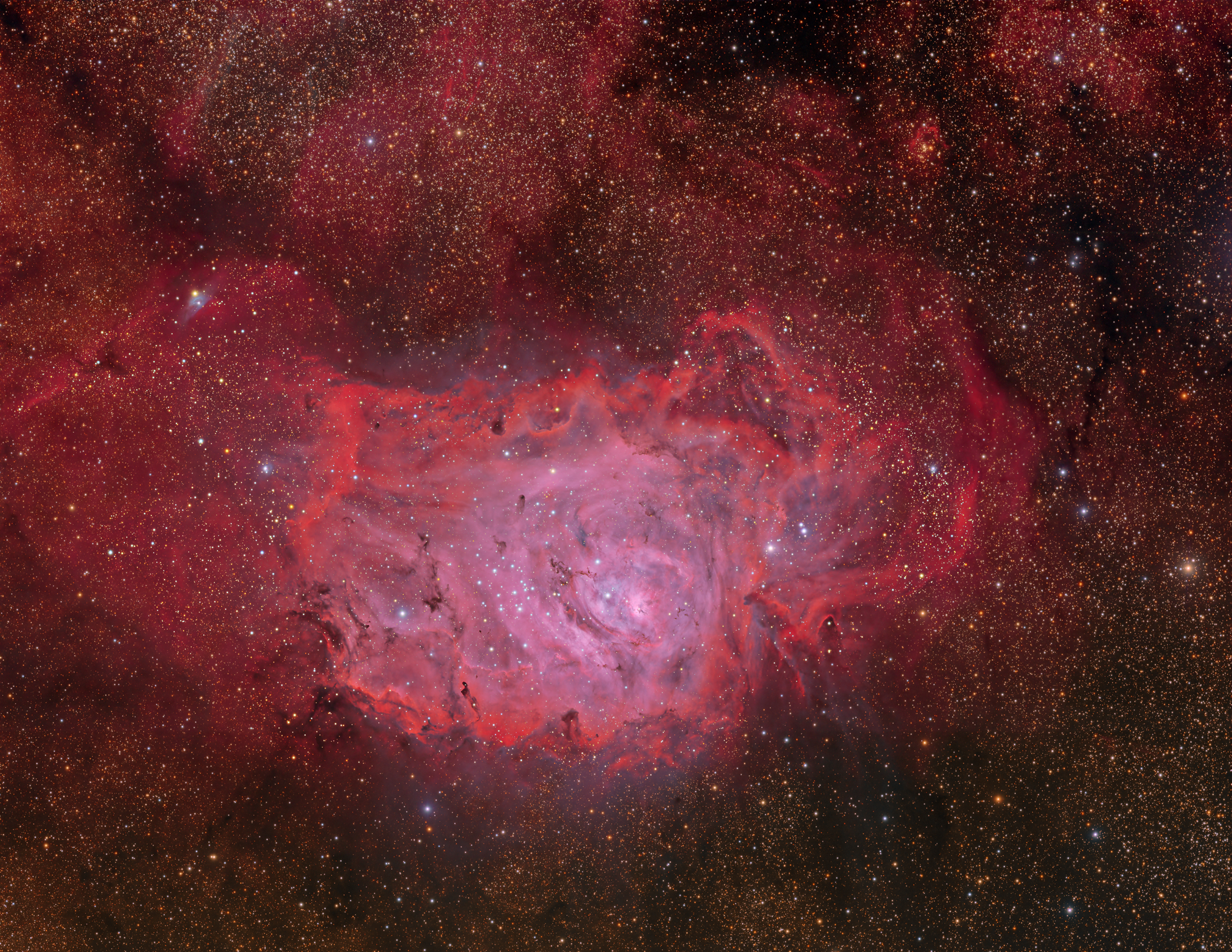
The above image was done conventionally (?) in Photoshop by adding the
starless OIII and H-Alpha to the pure RGB image as follows: H-Alpha
into the Red at 100% and Blue at 20% using Screen. OIII added to the
Green and Blue at 33% using Screen. Recombine. Some colour adjustments
and localized sharpening.
The next image is the conventional version but assembled in PixInsight
using the NBRGBCombine script:
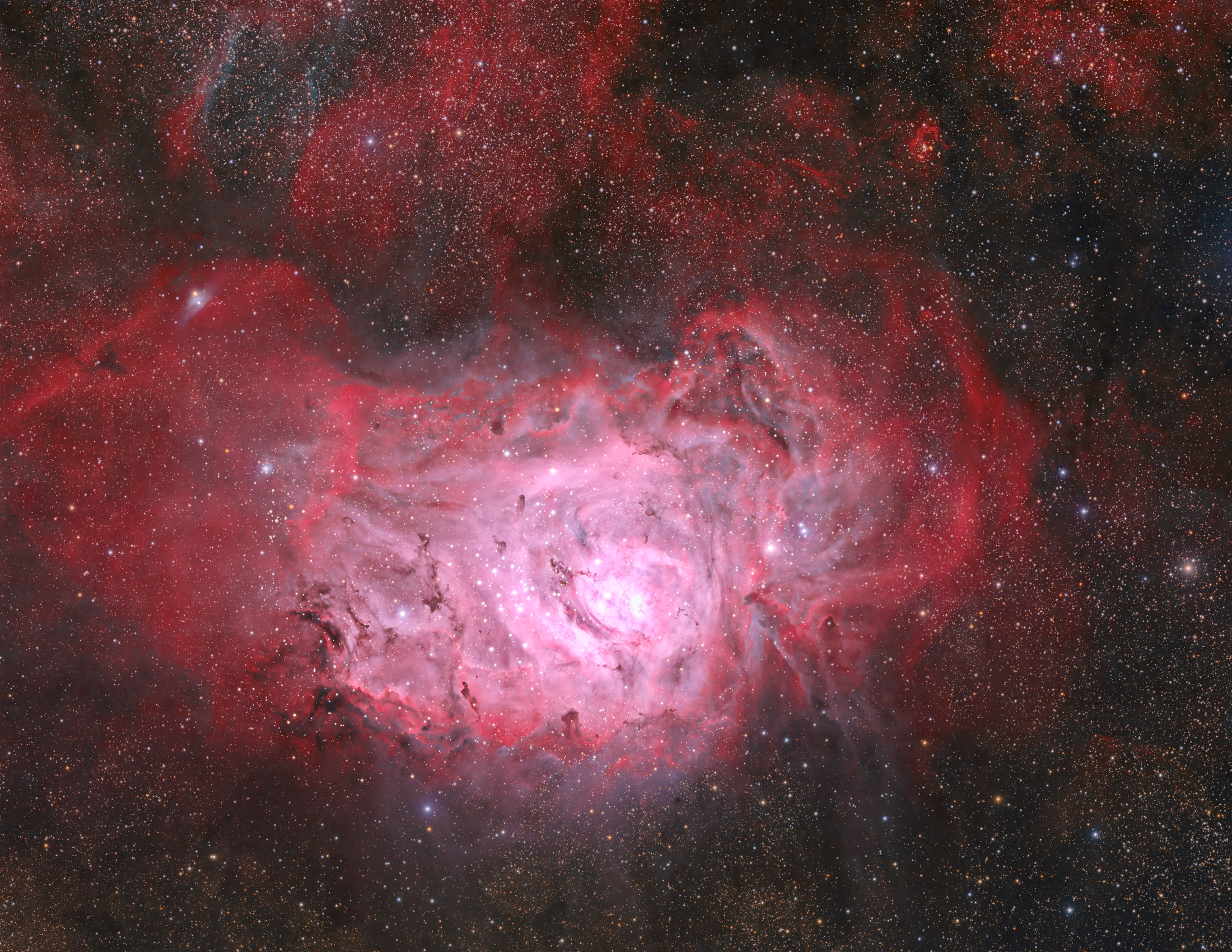
Above is the HOO+RGB via NBRGBCombine script in PixInsight.
Below is the HOO image assembled in PixInsight via the Foraxx script
then this was layered over the pure RGB in Photoshop. Subsequent tweaks
for sharpening etc.
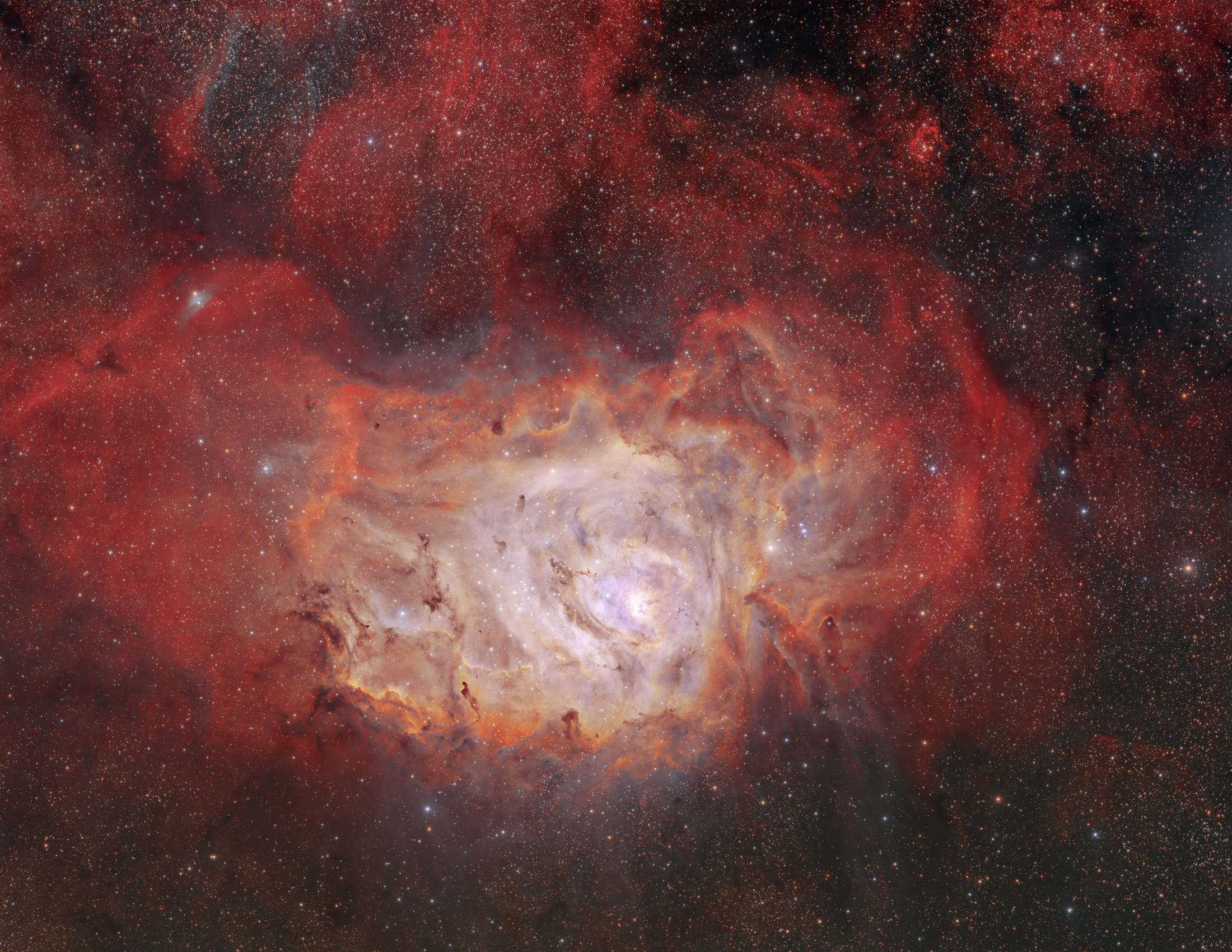
The Lagoon Nebula in Sagittarius
From SEDS.ORG:
Discovered by Hodierna about 1654. The Lagoon Nebula Messier 8 (M8, NGC
6523) is one of the finest and brightest star-forming regions in the
sky. It is a giant cloud of interstellar matter which is currently
undergoing vivid star formation, and has already formed a considerable
cluster of young stars.
This object has been discovered by Giovanni Battista
Hodierna before 1654, and classified it as "nebulosa," i.e. of
intermediate brightness. It was independently noted as a "nebula"
by John Flamsteed about 1680.
According to Kenneth Glyn Jones, the Lagoon Nebula has an apparent
extension of 90x40 minutes of arc, which is 3 x 1 1/3 the apparent
diameter of the full moon, and corresponds to about 140x60 light years
if our distance of 5,200 light years should be correct, which is a bit
uncertain; newer sources have 4850 (Glyn Jones) to 6500, but David J.
Eichler gives the value of 5,200 light years (Eichler 1996).
One of the remarkable features of the Lagoon Nebula is the presence of
dark nebulae known as 'globules' which are collapsing protostellar
clouds with diameters of about 10,000 AU (Astronomical
Units). Some of the more conspicuous globules have been
cataloged in E.E. Barnard's catalog of dark nebulae.
Within the brightest part of the Lagoon Nebula, a remarkable feature
can be seen, which according to its shape is called the "Hourglass
Nebula" (see our detailed photos). This feature was discovered
by John Herschel and occurs in a region where a vivid star formation
process appears to take place currently; the bright emission is caused
by heavy excitation of very hot, young stars, the illuminator of the
hourglass is the hot star Herschel 36 (mag 9.5, spectral class O7).
Closely by this feature is the apparently brightest of the stars
associated with the Lagoon Nebula, 9 Sagittarii (mag 5.97, spectral
class O5), which surely contributes a lot of the high energy radiation
which excites the nebula to shine.
Scope: Astro-Physics AP155EDF
Camera: Moravian Instruments G4 (16803 chip) w integrated FW and Gen II
Astrodon RGB
Mount: Paramount MX guided w SBIG ST-402ME / Borg 60mm piggyback
12/11/15 x 10 min RGB
11 x 20 min each for H-Alpha and OIII
Acquired with TheSkyX and CCD-Commander
Data
reduction and initial processing in PixInsight:
RGB: SPCC, BlurX, NoiseX, Curves, HistogramTransformation, Saturation
Boost to highlights.
H-Alpha: BlurX, NoiseX, StarX, Curves, HistogramTransformation,
LocalHistogramTransformatin on highlights
OIII: BlurX, NoiseX, StarX, Curves, HistogramTransformation,
LocalHistogramTransformatin on highlights
Foraxx script used to combine the Ha and OIII into a colour image
including stars.
NBRGBCombine script used to combine the starless Ha and OIII with the
RGB
Many additional tweaks in Photoshop CC
Click on each image to see it 2x this resolution and to resize it in
the
browser (which is 50% of the full resolution)
Lucknow,
Ontario
June/July 2024
Home