NGC2683
- aka - The UFO Galaxy
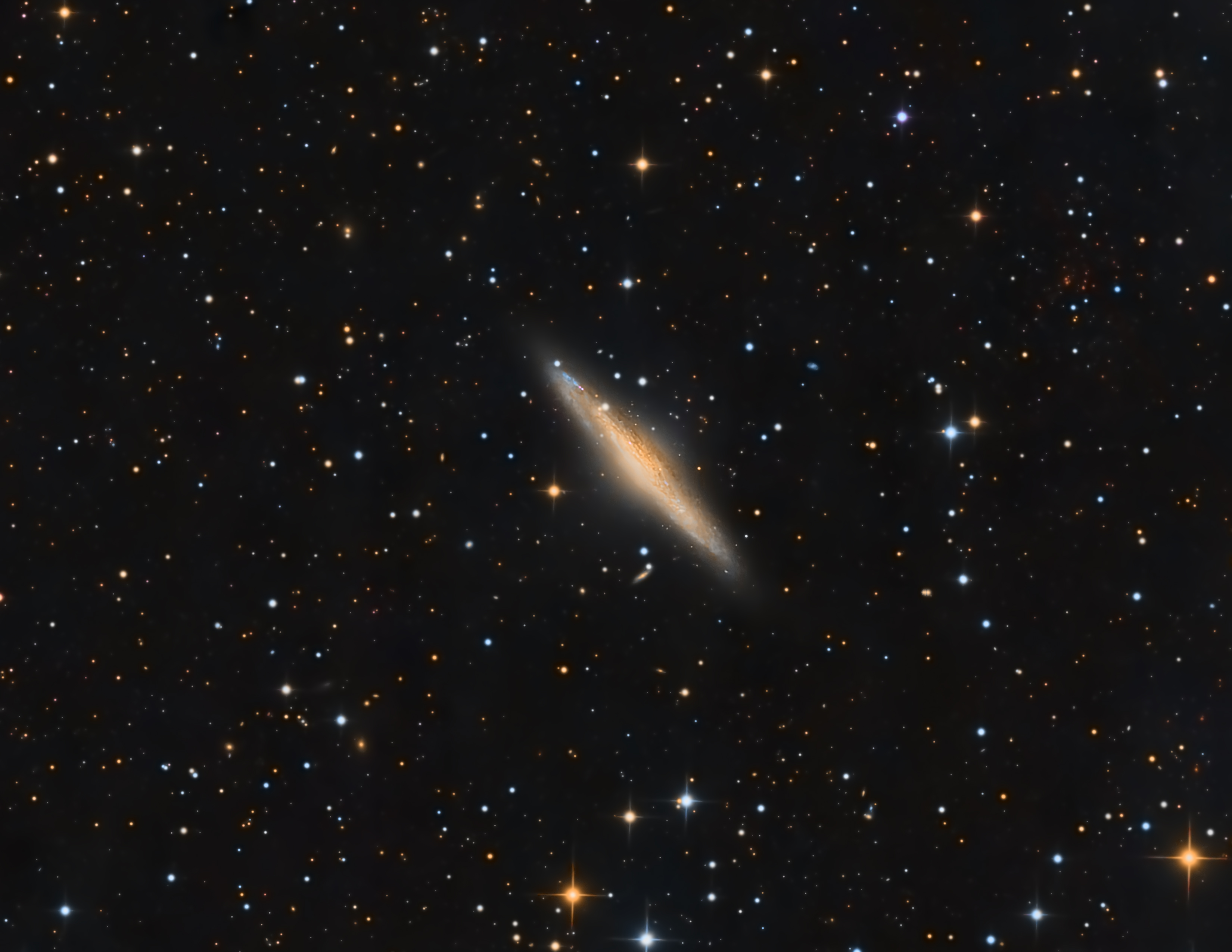
ngc2683 aka The UFO Galaxy
Scope: Planewave 12.5" CDK
Mount: Paramount ME (MKS5000)
Camera: Apogee U16M w Astrodon Gen II Filters
12 x 10 min Luminance
10/11/12 x 10 min each RGB
Acquired using CCD-Commander and TheSkyX
Calibration and RGB processing in PixInsight; same for Luminance
Luminance
Processing: GradientCorrection, BlurX, NoiseX, Levels, Curves. DBE
RGB
Processing: GradientCorrection, SPCC, BlurX, NoiseX, MultiScaleAdaptiveStretch, masked Saturation boost, DBE
Luminance added to the RGB via LRGB_Combine process
In Photoshop, a tiny bit of sharpening of the core, smoothing of the
background, some cosmetic cleanup and then crop to 8.5x11 format
Click on the image to see it full size.
===============
From Wikipedia, the free encyclopedia
Constellation Lynx
Right ascension 08h 52m 41.3s, Declination +33° 25′ 19″
Redshift 411 ± 1 km/s, Distance 30.53 ± 0.91 Mly (9.36 ± 0.28 Mpc)
Apparent magnitude (V) 10.6
Characteristics: Type SA(rs)b, Size 122 kly (37.5 kpc); Apparent size (V) 9.3′ × 2.2′
Other designations: UGC 4641, PGC 24930
NGC
2683 is a field spiral galaxy in the northern constellation of Lynx. It
was nicknamed the "UFO Galaxy" by the Astronaut Memorial Planetarium
and Observatory. It was discovered by the astronomer William Herschel
on February 5, 1788.
It
is viewed nearly edge-on from Earth's location in space and is located
about 30 million light-years away,[2] although previous estimates also
give distances between 16 and 25 million light-years.
NGC 2683 is receding from Earth at 410 km/s (250 mi/s), and from the Galactic Center at 375 km/s (233 mi/s).
===============
Lucknow, Ontario
Feb 2026
Home