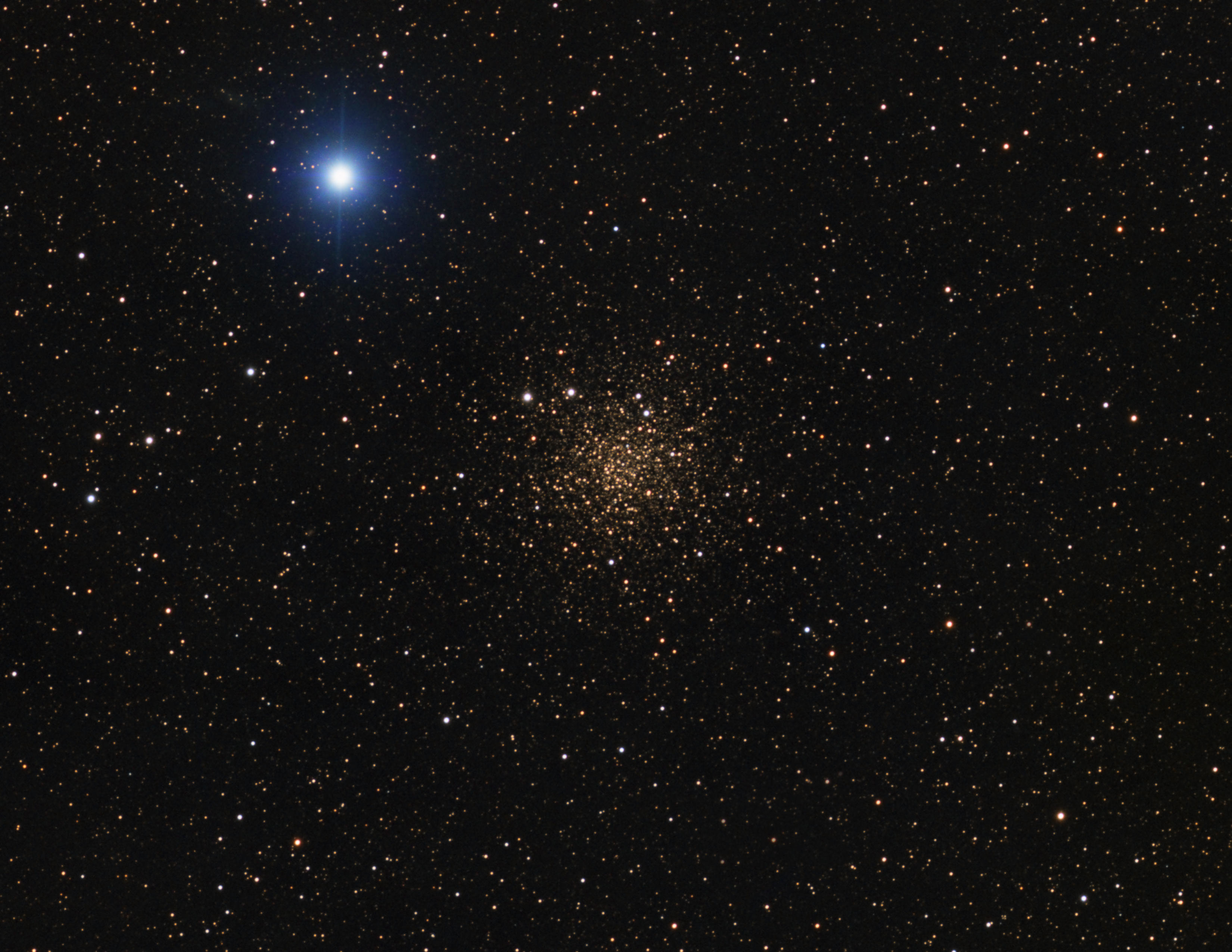
This globular cluster was included in the General Catalogue of John Herschel as GC 4301. It is a large and quite "open" globular cluster, as indicated by its concentration class XI.
NGC 6366 is quite faint and weakly concentrated even in intermediate-sized amateur telescopes. As its brightest stars are only of magnitude 13.6, larger telescopes are required to view them; the horizontal branch giants are of magnitude 15.7. The overall visual magnitude of 9.2, at its distance of 11,700 light years and taking into account the interstellar absorption in its direction, gives an absolute visual brightness of -5.77 magnitudes, or a luminosity of only about 20,000 times that of our sun. Compared to other globulars, the cluster is rather rich in elements heavier than Helium, which astronomers sometimes inacurately like to call metals. NGC 6366 is approaching us at 122 km/s.
-------------------------------